Assist
Where required, assists with the provision of analytical services, also ensures that proper disposal requirements are prescribed for the safe disposal of cannabis which is handled under the Act.
Learn MoreThe Content of this website is for MATURE audiences only.
By continuing to view the website you are claiming that you are 18 years or older.
Call: +1 (246) 421-4141 | Email: clo@bmcla.bb
Grounded in Growth · November 6–7, 2026
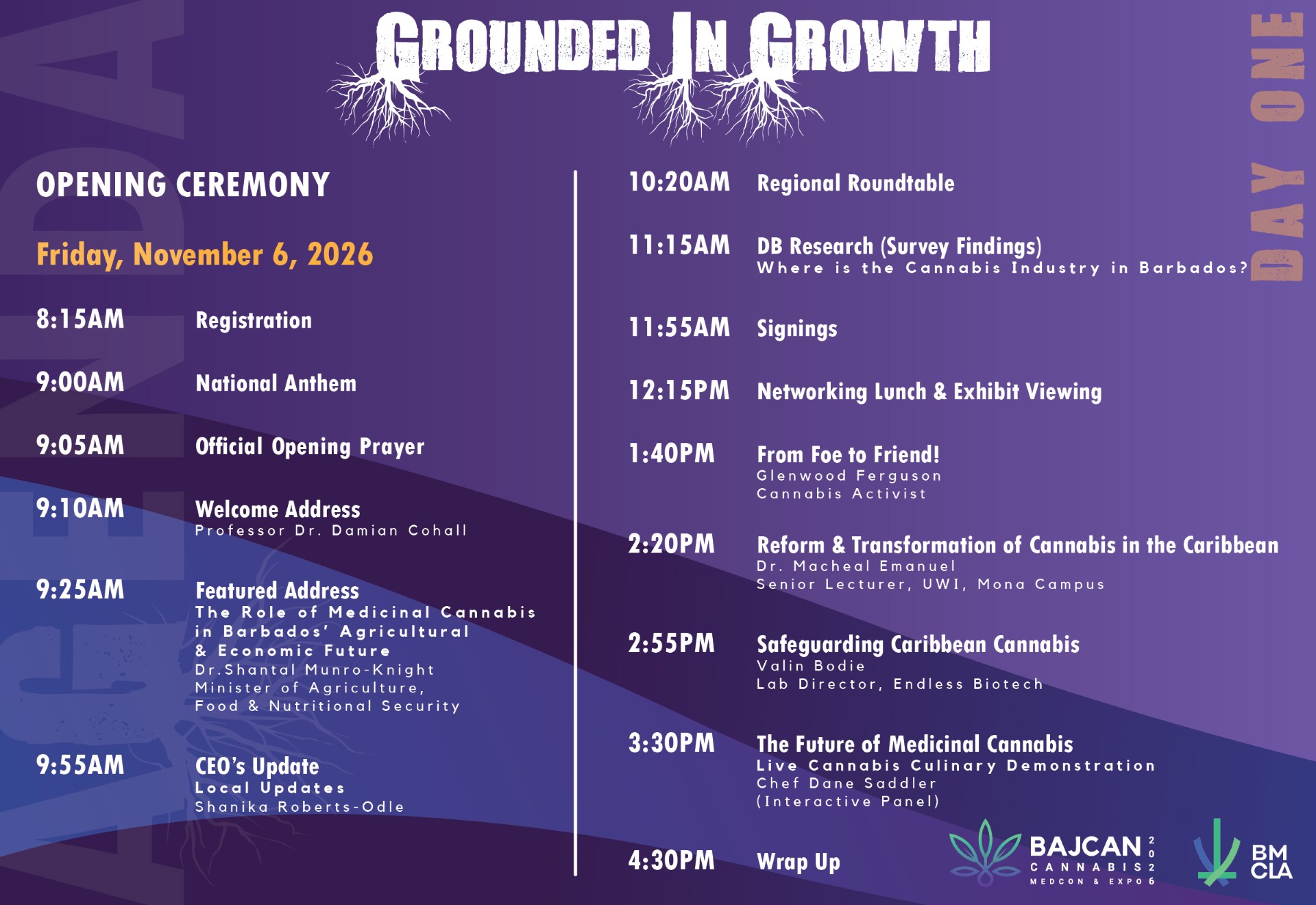
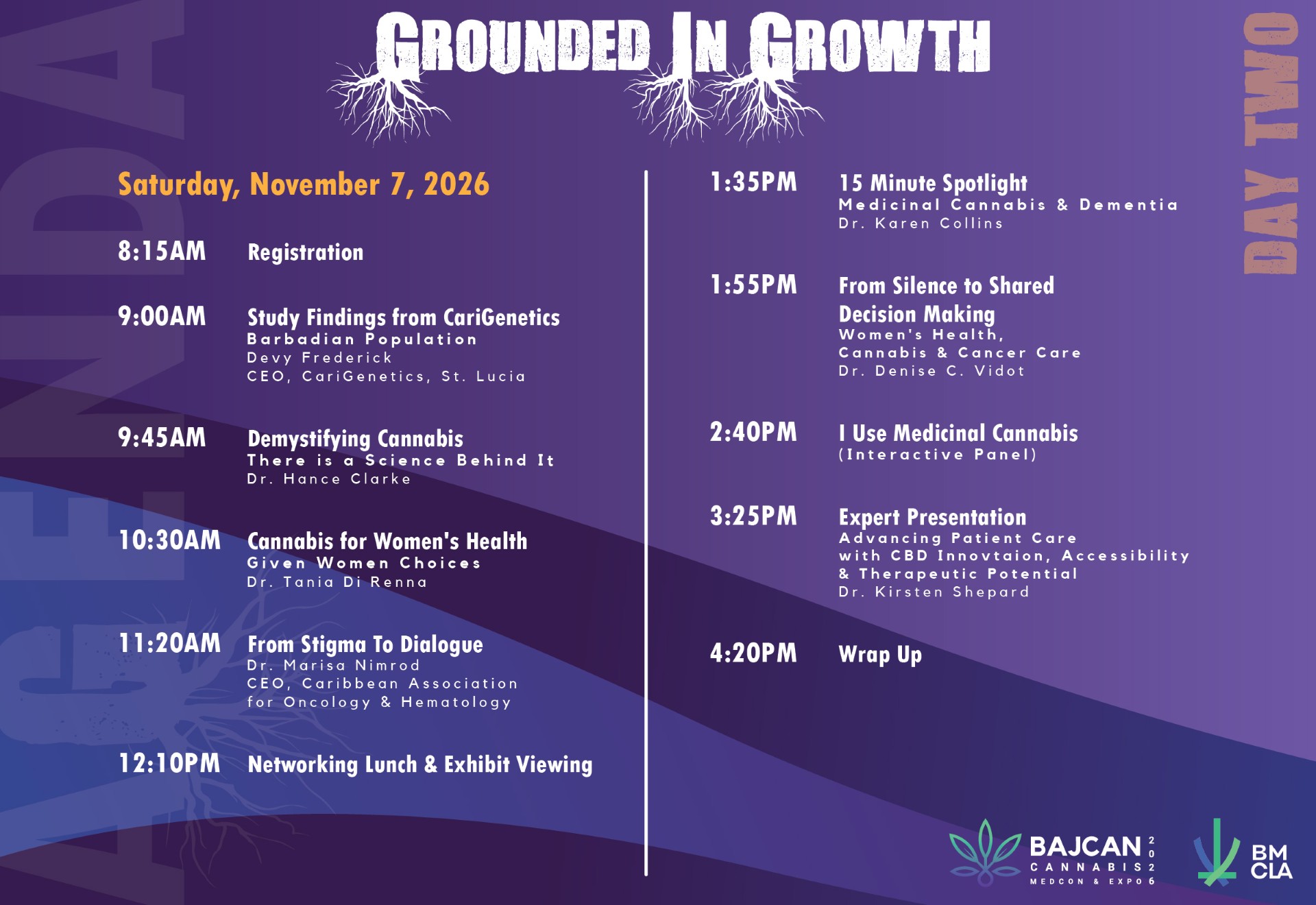
Select an agenda image to view it at full size.
Where required, assists with the provision of analytical services, also ensures that proper disposal requirements are prescribed for the safe disposal of cannabis which is handled under the Act.
Learn MoreDevelop policies, procedures and guidelines to establish the medicinal cannabis industry and to ensure that medicinal cannabis is available to patients in a safe and efficient manner.
Learn MoreIssues licences in relation to the handling of medicinal cannabis in accordance with the provisions of the Act, 2019, also provides for the distribution of educational materials etc.
Learn MoreRegulates the handling of medicinal cannabis, with the approval of the Barbados Medicinal Cannabis Licensing Board, establishes and maintains an electronic database.
Learn MoreGet the latest top news stories and updates from BMCLA and the Medicinal Cannabis Community. Find videos, articles and downloads on the latest top news stories in the region.


16. Can a minor be prescribed medicinal cannabis?
According to the Barbados Medicinal Cannabis Industry Act, 2019 the parent or guardian of a patient who is a minor shall obtain a certificate in writing from a medical practitioner certifying that the use of medicinal cannabis is necessary in the case of that minor, and the parent or guardian shall consent in writing to the use of medicinal cannabis for the treatment of the minor.
The Act also states that a parent or legal guardian of a patient who is a minor shall be deemed to be the caregiver for that minor unless that parent or legal guardian designates another person, or a person is designated by an order of the Court.
Any person who is under the age of 18 years shall not be designated as a caregiver.
17. How will sale of medicinal cannabis to minors be addressed, particularly in light of those studies that suggest adolescents and pre-adolescents are more susceptible to negative psychological and medical consequences from using cannabis?
There will be no sale of medicinal cannabis to minors. Possession of cannabis on or near school premises, the inclusion of a child or young person in the drug trade and the purchase of cannabis from a child or young person is illegal and on indictment could result in imprisonment for life (Drug Abuse (Prevention and Control) Act Chapter 131).
A parent or guardian of a patient who is a minor or young person can access medicinal cannabis via mechanisms described above. However, a person who is under the age of 18 years shall not be designated as a caregiver of a minor or young person.
Important Note:Cannabis affects the same biological system in the brain that is responsible for brain development. The earlier you start consuming cannabis, the more harm it can do. Starting as a teen, consuming frequently (daily or near daily) and over a long time (several months or years) increases the risk of mental health problems. These problems include dependence and disorders related to psychosis, anxiety and depression. [1] For more information, visit your doctor.
[1] Chadwick B, Miller ML, Hurd YL. Cannabis use during adolescent development: Susceptibility to psychiatric illness. Front Psychiatry 2013 Oct 14;4:129.
The BMCLA can suspend or revoke a license where:
the person issued the license is convicted of an offence under the Act;
the person issued with the license contravenes a term of condition of the license granted under the Act.
the Minister requires the suspension or revocation of the license in the interest of public health or public safety.
For more about the Barbados Medicinal Industry Act please click here
A person who is under the age of 18 years, or who is addicted to cannabis, shall not be designated as a caregiver.
11. How do you get medicinal cannabis?
A patient can only get access to medicinal cannabis as a prescription by a medical practitioner.
That prescription can only be filled by a pharmacist or authorised personnel in a pharmacy or therapeutic facility.
A pharmacist or authorised personnel in a pharmacy shall only dispense or supply medicinal cannabis on the submission by a patient or where applicable, a caregiver, of a prescription and a valid form of identification.
Upon dispensing medicinal cannabis to a patient (or, where applicable, a caregiver), a pharmacist or authorised personnel shall ensure that the label given in respect of the prescription has the information required by Pharmacy (Compounding and Dispensing of Drugs and Poisons) Regulations, 1986.
A pharmacist shall enter the information in a register kept by him/her and established for that purpose, in the prescribed manner.
A person who consumes medicinal cannabis without being authorised to use medicinal cannabis by a prescription or recommendation from a medical practitioner is guilty of an offence and is liable on conviction on indictment to a fine of $100 000 or to imprisonment for a term of 10 years or to both.
12. How is medicinal cannabis administered?
Medical cannabis can be administered by a variety of formulations which may include vapours, tinctures, oromucosal sprays, oral forms, transdermal patches, ointments and suppositories.
13. Will there be rigorous testing done to medicinal cannabis?
The BMCLA in conjunction with accredited testing laboratories will facilitate the testing of medicinal cannabis to ensure the products meet safety and efficacy requirements.
14. Will there be clear guidelines for prescribing medicinal cannabis for the use of patients or will doctors be left to experiment?
The BMCLA and its Board, are responsible for regulating the medicinal cannabis industry, through the formulation and implementation of appropriate policies, procedures and guidelines, as well as establishing the code of practice for practitioners in the industry. We work closely with the Ministry of Health and Wellness via its regulatory bodies such as the Barbados Drug Service to ensure safe and evidence-based treatment options for patients. Currently, there are five legally-approved medicinal cannabis drugs, placed on the National Drug Formulary. Patients can access these drugs under the provisions of Section 12 of the Drug Abuse (Prevention and Control) Act Cap 131.
15. Are there dose limitations?
In circumstances where a prescription by a medical practitioner requires repeated usage over a period of 3 months, a pharmacy or therapeutic facility shall not dispense to that patient more than 30-day supply of individual does at a time.
The Barbados Medicinal Cannabis Licensing Authority grants licenses to facilitate the cultivation, processing, transport and dispensing of medicinal cannabis to patients. The Medicinal Cannabis Industry Act, 2019 outlines that medicinal cannabis products can be prescribed by a medical practitioner. A Pharmacy with a retail distributor's license can dispense medicinal cannabis when presented by a patient with a prescription and a valid form of identification.
Currently, there are five legally-approved medicinal cannabis drugs, placed on the National Drug Formulary for specific indications, via approval from the Minister of Health and Wellness utilising Section 12 of the Drug Abuse (Control and Prevention) Act Cap 131.
Please speak to your doctor or pharmacist for more information on accessing medicinal cannabis.
Medicinal Cannabis is cannabis that is grown and sold pursuant to the Medicinal Cannabis Industry Act, 2019 that includes the seeds, immature plants as well as all parts of the plant, along with resin extracted from any part of the plant, every compound, manufacture, salt, derivative, mixture or preparation from cannabis; or cannabis concentrate; that is cultivated, processed, manufactured, distributed or sold under a licence from the BMCLA. As a medicine, it is prescribed and recommended by physicians to provide a therapeutic effect.